Queuing: it’s what the British are renowned for doing — and doing very well. Better than anyone else in the world, if reputation is to be believed.
But even for the best in the business, it doesn’t always come naturally, as recent events in Wales reveal.
In case you’ve missed it, it’s all been kicking off at Yr Wyddfa, also known as Snowdon.
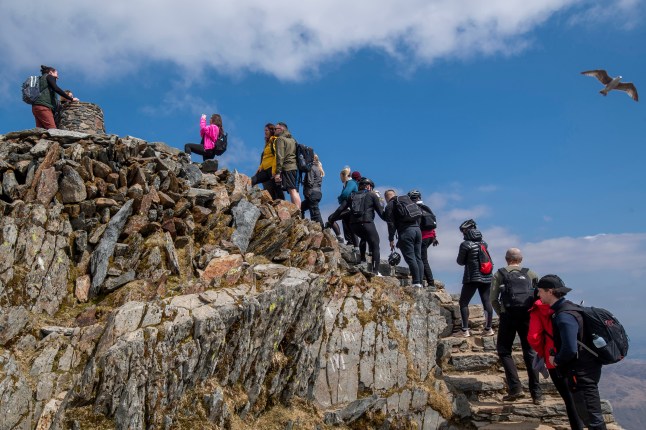
Heatwaves have drawn bumper summer crowds to Wales’ highest mountain, where climbers have reportedly waited more than an hour to reach the 1,085m-high summit.
There is no official queue system in place, but during busy periods hikers line up to take photos with the metal plate that marks the top. And here lies the problem.
Social media videos have shown arguments between queue-jumpers and people waiting their turn — none more viral than this Insta clip from Manchester man, Marc Screeton:
Marc, 27, said there was ‘no chance’ he’d queue on any mountain, but others said it is necessary for safety reasons.
Some argue that it should be different strokes for different folks.
If you’re tapping the summit and heading down again, fire ahead.
If you’re posing for pictures (i.e. doing it for the ‘gram), get in line.
The issue is being debated everywhere from Sky News to the BBC, and Marc tells us at Metro that he feels it’s been blown out of proportion.
‘I still feel the same and I would still never queue up on a mountain. If people want to queue, they can, but they can’t expect everyone else to do the same,’ he says.
‘It’s a little overwhelming, from what I thought was a harmless video, to blow up like it has is crazy.’
We want to know what you, our readers, think.
Should people queue to climb mountains?
-
Yes
-
No
Queuing is not always compulsory, but it is often an ‘unspoken’ social contract, according to an expert in moral philosophy.
Johann Go, assistant professor of ethics at University College London, told the BBC: ‘It’s not that I have to queue, but given that others are already restraining themselves, if I were to then jump the queue, I would be saying ‘to hell with them’ and that my time is more valuable.’
Etiquette expert Jo Hayes agrees.
‘If there was no queue, and people just barged past each other, people could potentially fall off the stairs, they would be crowded in like sardines it would be unpleasant, and very likely, unsafe,’ she said.
As it stands, there is no plan to tackle the Snowdon dispute.
A spokesperson for Eryri National Park Authority told Metro that its policy remains one of ‘self-policing’ at the summit.
He said: ‘Given how popular [it] is, particularly during peak times, some queuing can be expected.
‘We would encourage everyone visiting Yr Wyddfa and the wider National Park to be respectful of others, and to help ensure that everyone is able to enjoy their visit safely and responsibly.’
Jo doesn’t believe there should be a need to have anyone policing Snowdon.
‘Surely we can be kind, courteous, patient humans and wait our turn. Or, if patience isn’t a virtue, perhaps consider scaling this mountain at another time of year, when crowds are far thinner,’ she said.
‘I dare say you could dilly dally at the summit about to your hearts content during the autumn/winter months.’
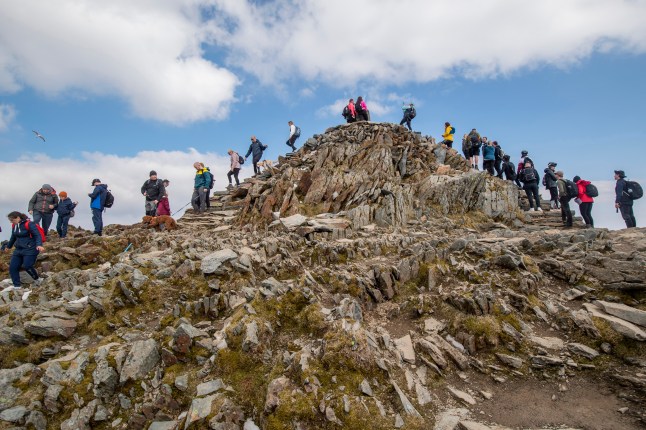
At 1,085 metres above sea level, the peak is a popular destination for hikers and the national park, also known as Snowdonia, attracts nearly 4 million people a year.
In May, two friends on a charity hike were booed and physically restrained by fellow walkers while climbing Snowdon after they bypassed queues to get to the top.
Jamie Richardson, 32, and Richard Thiedeman, 34, from Lincolnshire, were climbing Yr Wyddfa as part of the Three Peaks challenge to raise money for their friend who has motor neurone disease (MND).
Jamie told the BBC he had just touched the trig point when he heard someone say ‘you should be ashamed of yourself’.
Among the thousands of visitors to the mountain this summer was the Princess of Wales.
Kate also took on the Three Peaks challenge in June, climbing the highest mountains in Scotland, England and Wales – Ben Nevis, Scafell Pike and Snowdon – in 24 hours.
Kensington Palace said it believed Kate was the first member of the royal family to complete the challenge.
She took on the challenge to raise money for The Royal Marsden Cancer Charity and ‘explore life beyond diagnosis’.